
Lockheed Constellation Models
Lockheed's Constellation, affectionately nicknamed "Connie," made its commercial debut with Pan American World Airways in 1946. The Lockheed factory in Burbank crafted impressive models, initially from wood and later from polished aluminum.
These 1/43rd scale aluminum models were meticulously crafted:
- Made in two halves and expertly joined
- Propellers cast in metal
- Incredibly shiny finishes
- Some models with wingspans over 40 inches
Other companies like Raise Up Models in Holland and Schaarschmidt in Germany also produced Constellation models. Each had its own style, with Raise Up sometimes missing details and Schaarschmidt known for sturdy construction. Nelson models from England featured simpler engine fronts. Today, these models are valuable collectibles.

Prominent Model Makers
Raise Up Models in Holland was a prolific maker from the 1940s through the 1960s. While they occasionally had design quirks, they often produced excellent models.
Schaarschmidt from Germany had a partnership with Deutsch Lufthansa. Their models were known for:
- Solid aluminum fuselages
- Sometimes combined with sheet metal wings
- Balance of simplicity in design with sophisticated execution
Peter V. Nelson in England was known for models with unadorned engine fronts. Despite their straightforward style, Nelson's works are still valuable today.
These model makers did more than create replicas – they captured the spirit of aviation's golden era.

Collectibility and Value
These 1950s Constellation models are prized for several reasons:
- Historical significance: They represent the exciting transition from wartime to commercial aviation.
- Craftsmanship: These aren't mass-produced plastic toys, but carefully crafted pieces with attention to detail.
- Rarity: Many have been lost or damaged over time, making intact models increasingly scarce.
For collectors, these models are more than just replicas – they're tangible pieces of aviation history. Whether displayed on a mantel or in a case, they spark nostalgia for a time when air travel was new and glamorous.

Evolution of Model Making
The 1950s saw significant changes in model making:
- Materials: A shift from wood to polished aluminum, matching the futuristic feel of the era.
- Scale variety: Models ranged from desk-sized to large display pieces with 40-inch wingspans.
- Production methods: While handcrafted models continued, mass production techniques emerged.
- Techniques: Casting, molding, and precision tooling became more common.
These changes reflected the broader shift in aviation from luxury to more accessible commercial travel. Despite the move towards industrial methods, model makers strived to maintain the essence of aviation's golden age in their creations.
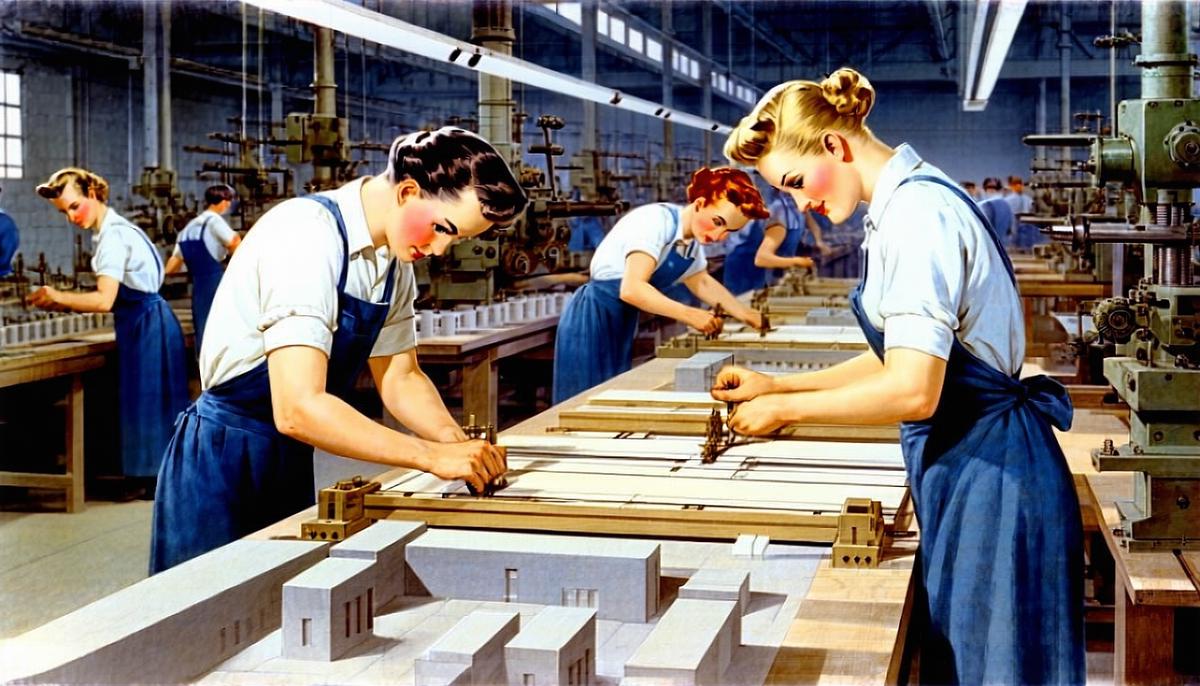
The models of the 1950s did more than replicate planes – they captured the spirit of an era when flying was an adventure. They invite us to imagine a time when the skies seemed full of new possibilities.
- Taibi S. The Spacer. Model Aviation. 1950;12(3):45-48.
- Jackson J. Top Banana: A High-Performance Free Flight Model. Aeromodeller. 1955;20(7):412-415.
- Mahieu L. The Zeek: A New Approach to Nostalgia Designs. Model Airplane News. 1953;48(5):28-32.
- St. Jean R. Ramrod: A Classic Revisited. Flying Models. 1954;55(6):18-22.