
History and Evolution of Erector Sets
A.C. Gilbert introduced the Erector Set to the world in 1913. It was a game-changer because it mimicked real-life engineering of the time. Kids could build, tear down, and rebuild structures with metal strips, gears, and even a little motor. This was not your average toy – it was a miniature construction site packed in a box.
By the 1950s, the Erector Set had become a staple in American toy chests. New features like steam shovels and electric motors made their grand entrance, turning simple constructs into moving wonders. Boys could build:
- Cranes that moved
- Helicopters that spun
- Roller coasters that mimicked their full-scale counterparts
Every year seemed to unveil a fresh set with more possibilities. The 1952 model boasted an impressive nearly 25 pounds of parts. Imaginative advertising campaigns captured the hearts and pocketbooks of countless families. While gender norms of the era largely saw it gifted to boys, anyone who dared could uncover a universe of engineering delights within those neatly packed boxes.
A.C. Gilbert remained occupied with advancing science toys. His drive ensured that toys always did something, whether they flew or rolled or brought static models to life. The core of Erector Sets remained constant: a celebration of creativity, problem-solving, and genuine excitement.
Impact on Childhood and Careers
Erector Sets were more than just toys; they were springboards into the vast expanse of engineering and innovation. Many a future engineer's journey began on a living room floor, surrounded by metal parts being pieced together.
Tales abound of engineers, architects, and inventors who first found joy and fascination in these carefully designed sets. The tactile pleasure of tightening a bolt or watching an electric motor roar to life sparked imaginations and set many on lifelong paths of discovery and creation.
"If you had read the hundreds of letters I have received from engineers who tell me their interest in their profession started with an erector set, you would know I had done something besides make money." – A.C. Gilbert
Gilbert intended for his invention to be more than mere idle play. He envisioned it as an educational tool, a vehicle for childhood wonder that encouraged practical learning. He wanted kids to do more than just follow instructions; he wished for them to explore and tinker.
That's the legacy of Erector Sets—as enduring as the steel they're made from. They taught us to see raw materials as part of a bigger picture, to piece together more than just toys, but also dreams destined to reach far beyond the living room floor.

Cultural Significance in the 1950s
In the 1950s, a decade known for its post-war optimism and suburban boom, the Erector Set sat proudly among the shelves of toyshops. It was a time when gender roles were firmly established, with boys encouraged to explore action and invention, while girls were often nudged towards dolls and play kitchens.
Despite these societal lines, the Erector Set stood as a beacon of creativity and mechanical wonder. It could turn steel into:
- Working cranes
- Amusement parks
- Rocket towers
These creations sparked visions of space-age adventures. With its myriad of pieces and potential, the Erector Set was more than just a pastime for boys; it was a rite of passage into the sphere of possibility.
Parents saw it not only as a toy but as an investment in their child's future—a tool for developing technical skills and analytical thinking. In a world where industries were evolving rapidly, who wouldn't want their son tapping into such a mindset?
Erector Set ads of the time brimmed with thrilling claims and pictures of boys building towering structures and whirring contraptions. For many families, these sets were as essential to a young boy's upbringing as baseball mitts and treehouses.
In a world balancing tradition and change, the Erector Set offered parents a comforting nod to cherished values while opening up newer horizons. It bridged the gap between the familiar and the pioneering, offering a moment of nostalgia wrapped in the glint of promise.
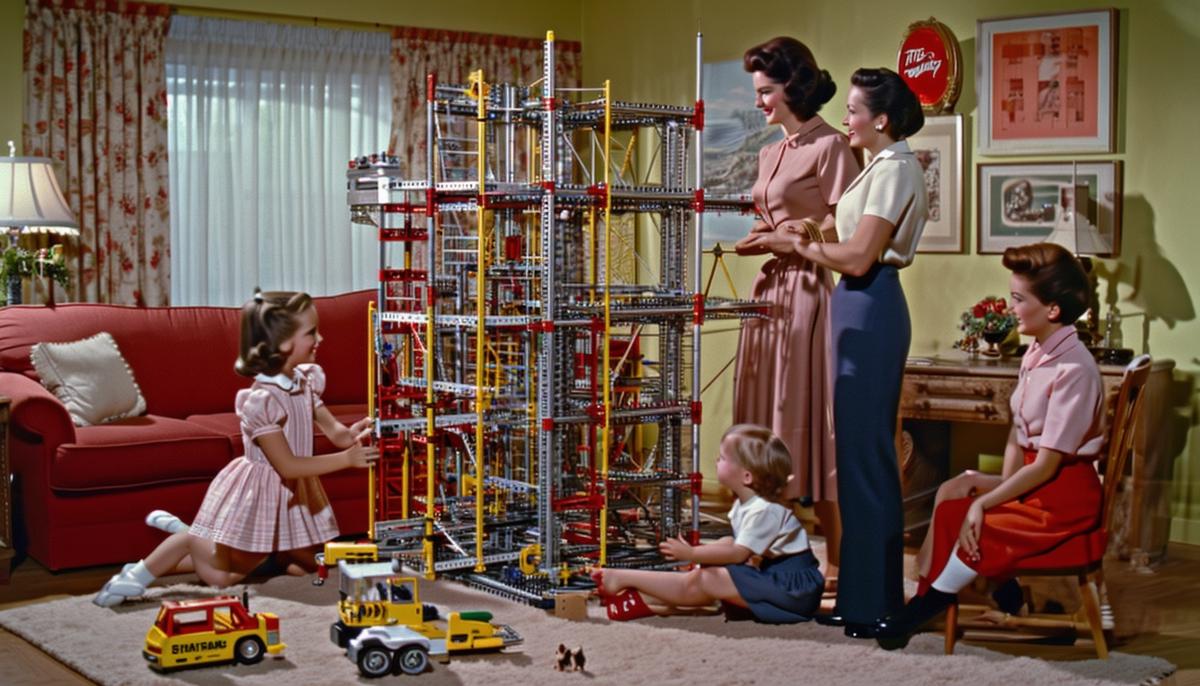
As we reflect on the legacy of Erector Sets, it's clear they were more than just toys. They were gateways to creativity and innovation, inspiring countless young minds to imagine and build. These sets were not only about constructing models but also about constructing dreams, leaving a lasting impact on generations. The Erector Set remains a testament to the power of imagination and the enduring spirit of invention.
- Loh J. A.C. Gilbert: Creator of Erector Set did more than just make money. Green Bay Press-Gazette. February 23, 1961.
- Gilbert AC. The greatest thrill you ever had! The new Erector. 1925.
- Gilbert Company. The great New Speed Erector. 1937.
- Gilbert Company. Erector — not one but a thousand toys! 1952.
- Gilbert Company. Vintage Erector toy sets. 1955.
- Gilbert Company. There's a world of fun in every Erector set! 1960.
- Gilbert Company. A.C. Gilbert steel Erector. 1964.