
The Origin of Air Raid Drills
Air raid drills in the 1950s were as much a part of school routine as math quizzes and recess games. It all began when the Soviets detonated their first atomic bomb in 1949. This led to the Federal Civil Defense Administration (FCDA) being established in 1951. Their job? Teach us how to stay safe if the Soviets decided to attack.
To school kids like me, the drills seemed a bit like a game. Our teacher would give us the lowdown:
- Head to the hallway
- Keep away from the windows
- Get low
- Cover up
Pretty straightforward, though why a desk was supposed to save us from an A-bomb was anyone's guess.
A small turtle named Bert became pretty famous around this time. Bert the Turtle hopped off the pages of comic books and onto classroom screens, showing us how to duck and cover like it was something we were born to do. It was catchy, let me tell you.
Air-raid sirens blared not just on school grounds but also on rooftops across town. These "walls of death"—as folks dramatically called them—meant we had to scramble to windowless spots whenever drills sounded.
Under that Atomic Age sky, a sense of unease buzzed like a persistent fly. We figured the government folks must've wanted to give us a bit of hope with these precautions. Yet, for us kids, there wasn't much room for understanding; school was supposed to be about lunchboxes, crushes, and pop quizzes, not the apocalypse.
Strangely enough, this routine taught us more than ducking and covering. We learned the art of carrying on—of finding fun in even the direst drills, and of understanding that sometimes, laughter was the only armor we needed.
The Drill Experience
Duck and cover—it was practically the anthem of our school days. When the school bell rang its special ring, our ears would perk up, and away we went. Our teachers morphed from their usual state into drill sergeants, guiding us with the precision of someone who knew not only how to conjugate a verb but also how to keep us alive in case of an unexpected Soviet telegram.
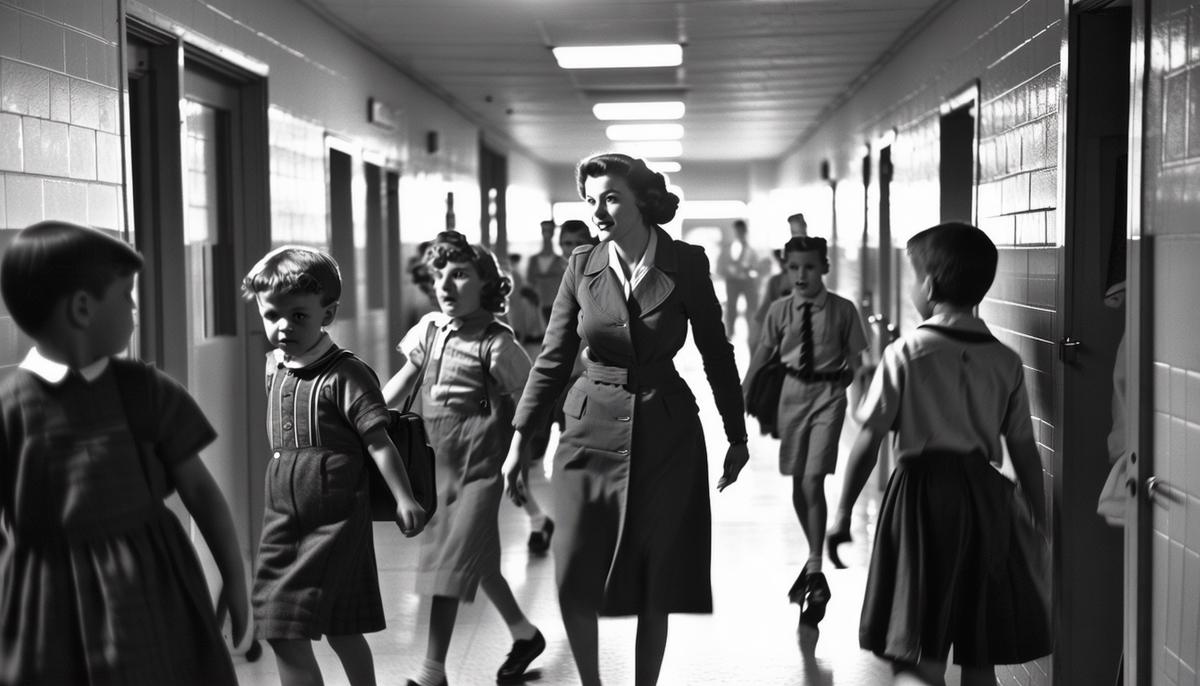
In a matter of minutes, we transformed from classroom-bound students to Cold War warriors as we marched down those halls to "safety." Teachers herded us like sheep, directing us to crouch down with our left forearms tucked under our foreheads and our right arms over our hearts—or at least, that's how I remember it.
"Form two lines," she barked sternly. We obliged, filing out the doorway.
Despite the cartoon magic of Bert the Turtle, the atmosphere could become quite tense. Many students fought to suppress giggles—there's something inherently funny about hiding from an apocalyptic mushroom cloud under your desk, after all. Yet, for some, the laughter hid anxiety.
The teachers wore responsibility like armor, determined to preserve the safety and innocence of a classroom pack in the face of a world gone mad. I think back on their poise, commanding yet kind, and how they seemed to shield us from a reality we couldn't begin to fathom.
Even amid the drills, little hearts beat faster—though sometimes from the fun of it all as much as from fear—wondering if Hayley from geography would finally notice how brave you were. Because when the world feels like it might crumble, you cling to what you know: friends, school, and the hope that today's lesson just might save your life.
Effectiveness and Criticism
Looking back, the big question remains: how effective were these air raid drills, really? A wooden desk hardly constitutes a fortified bunker against an atomic blast. Let's be real: desks are fantastic for holding our spelling tests or secret bubble gum stashes, but shielding us from nuclear explosions? Not so much.
Critics pointed out what us kiddos didn't quite grasp at the time: "duck and cover" was more pageantry than protection. Beyond the practical limitations, there's the deeper critique about the psychological toll these drills exacted. Imagine being 10 years old, just learning about dinosaurs or the solar system, and then being told you need to practice hiding from a world-ending cataclysm.
Some educators proposed turning away from these scare tactics to teach more about the countries across the ocean, advocating for knowledge as a better shield than any desk leg or basement bunker.
Yet, for all the criticisms, there's a strange sort of nostalgic affection for those times—a wry smile remembering the drills as part of our shared cultural experience. Eventually, we pieced together the larger-than-life farce behind the curtains, questioning what actual good would come from all that ducking and covering.
When history moved on, those once-stringent drills faded into history—more curio than cautionary exercise. We found a way to turn anxiety into a kind of playground theater, one where the villain was unseen and the heroes were—you guessed it—a classroom full of kids with nothing more than a wooden desk as their shield.
Legacy and Modern Relevance
Looking back, those air raid drills might seem quaint when held up to our current understanding of nuclear warfare. Yet, they've left a mark on the baby boomer generation—the folks who lived through the 50s and its symphony of atomic alarms.
For those who experienced the tick-tock of the Cold War clock, the drills are a nostalgic reminder of a time when schoolyard worries included more than just making the football team or nailing the lead role in the school play. Who could forget the odd comfort of ducking beneath a desk, as though that slab of wood held the magical power to stave off the end of the world?
While we're aware that those drills wouldn't stand a chance against today's nuclear arsenals, the strategy holds some relics of practicality. In an era concerned with a rogue nuclear attack or the detonation of a dirty bomb, some tactics could be seen as more than just a show. It's about buying precious minutes, time to escape intense heat and flying debris.
Though the fallout shelters of the 50s have mostly fallen into disrepair, the underlying lesson remains. In emergencies—nuclear or otherwise—speedy access to cover is key. Even today, experts recommend finding the most secure indoor spaces ASAP.
It's a strange twist of fate that what seemed like relics of a bygone era could find fresh relevance against modern threats. Lessons of preparedness, once drilled into us with cartoon turtles and air raid sirens, may still hold whispers of wisdom. Perhaps what's most worthwhile is the reminder of resilience—not just in the face of Cold War threats, but in finding courage amid uncertainty.

As we look back on those days of air raid drills, one truth stands out: the resilience of the human spirit. Even amid uncertainty, we found ways to laugh, learn, and carry on. The drills may have been more theater than protection, but they taught us to face challenges with courage and a touch of humor. It's a reminder that, no matter the threat, life continues—one school bell at a time.
- Flanagan D. Portland Schools Map Air Raid Precautions. Oregon Journal.
- Stoudt WI Jr. Air raid sirens in Reading. Reading Eagle.
- Kelly K. Duck and Cover: It's the 60th Anniversary of the Nuclear War Film. Huffington Post.
- Reynolds G. Cold War civil defense makes comeback. USA Today.
- Schlegelmilch J. National Center for Disaster Preparedness, Columbia University Earth Institute.