
Eisenhower's Introduction to Painting
Dwight D. Eisenhower, known for his leadership in war and politics, found an unexpected hobby in watercolor painting. His interest was sparked by Winston Churchill's artistic pursuits and watching artist Thomas E. Stephens paint a portrait of Mamie Eisenhower.
Eisenhower's first attempt at painting was copying Mamie's portrait. With no formal training, he approached it with a mix of seriousness and humor. The result was far from perfect, but it brought laughter and joy to those who saw it.
For Eisenhower, painting wasn't about mastery but about relaxation and personal growth. He often referred to his creations as "daubs," acknowledging their amateur status. This humble approach to art became a source of peace for the former general and president, much like enjoying a round of golf.
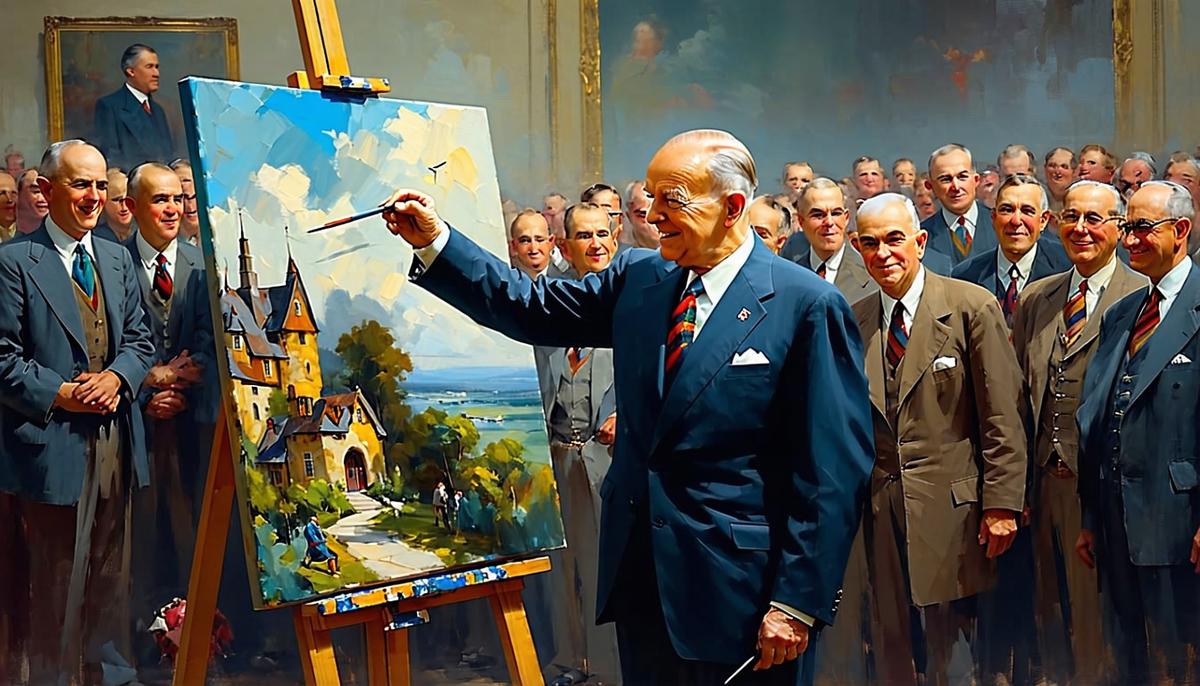
Watercolor vs Oil Painting
Eisenhower's artistic journey took an interesting turn when he explored watercolor painting. During a session with young artist Jim Hamil at Hallmark headquarters, Eisenhower learned the differences between oil and watercolor techniques.
- Oil painting allows for corrections and layering
- Watercolors demand precision and quick thinking
Hamil taught Eisenhower about using a flat surface to control the watery colors and techniques like washes and gradients.
This experience opened up a new world for Eisenhower. The spontaneity and transparency of watercolors offered a refreshing contrast to the more controlled nature of oils. It was like finding a new way to unwind, adding variety to his artistic pursuits.
Painting as a Leisure Activity
For Eisenhower, painting became a refuge from the pressures of presidency. Whether at the White House or Camp David, he found moments of peace with his brushes and paints.
His subjects often included landscapes reminiscent of his Kansas childhood or scenes of family life. These paintings allowed him to reconnect with simpler times and reflect on cherished memories.
More than just creating art, painting served as a form of meditation for Eisenhower. It helped him decompress and maintain his positive outlook amidst the challenges of leadership. Through this hobby, he found a way to recharge and approach each day with renewed energy.
The Paint-by-Numbers Connection
A lighthearted chapter in Eisenhower's artistic story involves paint-by-numbers kits. Thomas E. Stephens, Eisenhower's appointment secretary, playfully distributed these kits to cabinet members, claiming it was a request from the president.
Soon, the West Wing office became an impromptu gallery of colorful creations by some of the nation's top officials. Today, visitors to the Eisenhower Museum's Special Exhibit Gallery can see the 'By The Numbers' display, showcasing these unique pieces.
"At first glance, it appears to be a typical art exhibit," explains curator William Snyder. "We tend to associate these names—Hoover, Goodpaster, Rockefeller—as key historical figures, or Ethel Merman as the famous Broadway star. You don't expect to see a completed paint-by-number piece with their signature on it. This exhibit shows a more personal, human side of the Eisenhower administration."
The exhibit features works by political figures like Herbert Hoover and Clare Boothe Luce, alongside those of artists like Rockefeller. It's a quirky reminder of how even in the serious world of politics, there was room for fun and creativity.

Public Perception and Legacy
Eisenhower's painting hobby offered the public a different view of the man behind the presidency. People found it both humanizing and endearing to see a world leader engaged in such a relatable pastime.
Today, Eisenhower's paintings are more than just curiosities. They provide insight into his character and the era he lived in. The exhibits featuring his work, including the paint-by-numbers pieces, offer a unique connection to 1950s America.
While it's important not to overstate Eisenhower's artistic skills, his paintings remind us that creativity doesn't require mastery to be valuable. They represent the joy of trying something new and finding balance in life, even under great responsibility.
Eisenhower's artistic legacy encourages us to embrace hobbies and interests outside our main roles, showing that even world leaders can find time for simple pleasures.
Eisenhower's painting hobby shows us the value of pursuing creative interests, regardless of our main roles in life. It reminds us that finding joy in new experiences can help us maintain balance and perspective, even in the face of great responsibilities.
- Tudico A. By The Numbers: New Exhibit Features Paint-by-Number Artwork at Eisenhower Presidential Library. National Archives News. February 17, 2023.
- Eisenhower DD. Letter to Winston Churchill. 1950.