
Origins and Evolution of Flash Gordon
Flash Gordon burst onto the scene in 1934, thanks to Alex Raymond. Initially, this comic strip was created to compete with Buck Rogers. Flash's universe was a blend of dazzling worlds and eccentric characters that caught everyone's attention.
Flash wasn't your average hero. He started as a polo player who ended up rocketing to new adventures. Along with Dale Arden and Dr. Hans Zarkov, Flash landed on the planet Mongo to stop a collision with Earth. Their main nemesis, Ming the Merciless, brought a whole new level of villainy to the table.
The comic took off, with Flash's escapades spanning various kingdoms and regions, each with its own villains:
- Prince Barin's forests
- Queen Fria's icy domain
- King Kala's underwater realm
As time went on, Flash Gordon adapted to other media. By the 1950s, Flash became an astronaut, exploring even more areas at warp speed. The storylines expanded with new villains like Azura, the Witch Queen, and Brazor, each bringing fresh trouble.
Flash's adventures didn't just stick to paper. His exploits leaped into cinema and television, making quite an impact on the silver screen. Theater owners became fans, reserving reels for both morning and evening showtimes.
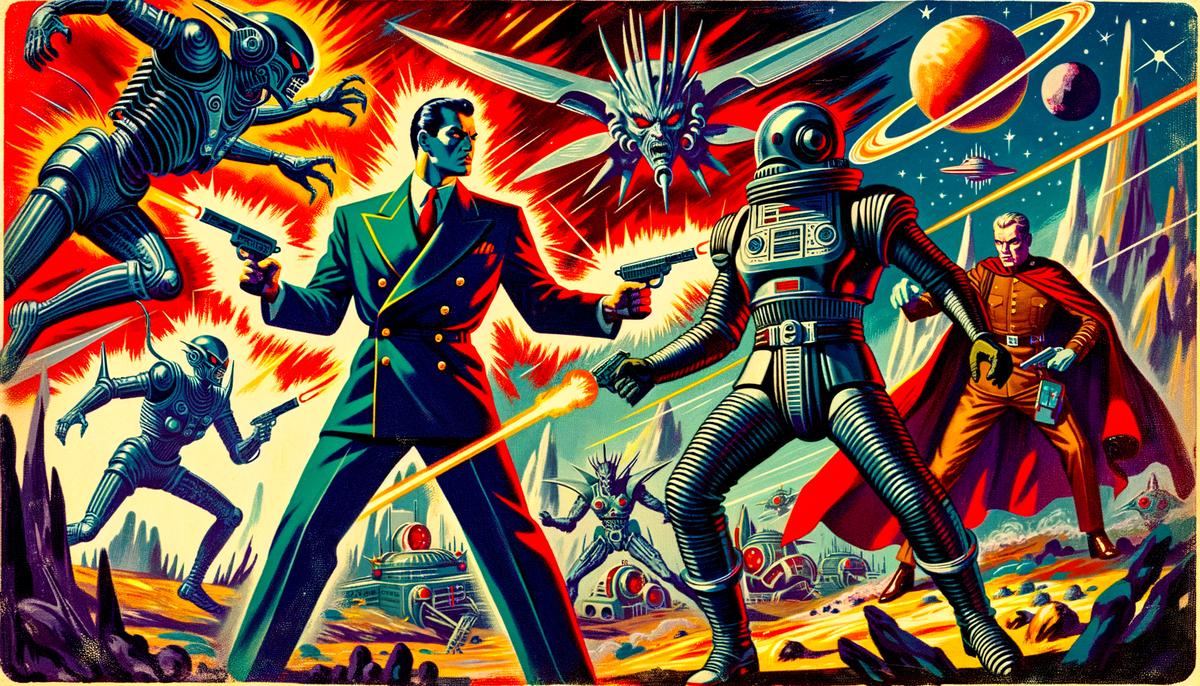
The 1950s lithographs offered a visual feast of Flash's adventures, showcasing an era's longing for discovery and heroics. These rich visuals took people to places many had only dreamed of, offering a glimpse into interstellar adventures and cosmic showdowns.
Flash Gordon in the 1950s
In the 1950s, Flash Gordon was everywhere. His adventures expanded beyond comic strips into comic books, movie serials, and merchandise. Fans couldn't get enough of the thrill and promise of new frontiers.
The movie serials were a big hit. Theaters buzzed with excitement as people of all ages lined up to see Flash's latest battle against rogue planets or Ming's dastardly plots. These bite-sized adventures kept folks coming back for more.
Flash's universe also expanded with tie-in merchandise:
- Action figures
- Ray guns
- Posters
These items allowed kids to bring the interstellar action home, letting fans play out their own Flash Gordon adventures.
Flash Gordon embodied the 1950s sci-fi boom, capturing the era's optimism and wonder. He took dreams of space travel and turned them into exciting stories that felt almost real. His influence on science fiction storytelling would ripple through the decades, even inspiring George Lucas in creating Star Wars.
Collectible Lithographs and Their Value
Flash Gordon lithographs from the 1950s are prized by collectors. These pieces capture the excitement of an era when space heroes fired up people's imaginations. But what makes them so valuable?
Condition is key. A lithograph in mint condition, free from creases, tears, or faded colors, can fetch top dollar. It's like finding a pristine piece of sci-fi history.
Rarity also plays a big role. Limited production runs or regional exclusives are especially sought after. The scarcer a lithograph is, the more collectors are willing to pay.
These lithographs have historical significance too. They offer a glimpse into a post-war world eager for new frontiers. Each piece is like a postcard from a time when space exploration was capturing hearts and minds.
The auction market for Flash Gordon lithographs can be pretty exciting. Collectors weigh factors like:
- Authenticity
- Provenance
- Sentimental value
Whether you're a serious investor or a fan looking for a piece of 1950s nostalgia, these lithographs are more than just collectibles – they're windows into an age of adventure and possibility.
Flash Gordon's Influence on Sci-Fi
Flash Gordon left a big mark on science fiction. The comic strip opened up new possibilities for what sci-fi stories could be, paving the way for future creators.
Take George Lucas, for example. Before Star Wars, Lucas wanted to bring Flash Gordon to the big screen. Unable to get the rights, he created his own space saga. Star Wars owes a lot to Flash Gordon's cosmic adventures.
Flash Gordon's themes became staples of the genre:
- Epic Good vs. Evil stories
- Dashing heroes battling galaxy-spanning foes
- Escapism and hope amidst impossible odds
The stories expanded imaginations, painting a vast canvas for creators to explore. From Doctor Who to Guardians of the Galaxy, you can see echoes of Flash's journeys. His cinematic presence influenced the visual style of sci-fi entertainment, with ray guns and mesmerizing alien landscapes.
Flash Gordon also tapped into the human desire to explore. It presented a fantastic vision of the future that saw us venturing beyond Earth, eager to discover what lay in the cosmos.
So next time you enjoy a thrilling sci-fi story, remember Flash Gordon's part in shaping the genre. His tales didn't just entertain – they inspired generations to dream big and reach for the stars.

Flash Gordon's adventures remind us of a time when imagination ran wild. His legacy shows how a good story can inspire people across generations to dream bigger and bolder.
- Raymond A. Flash Gordon. King Features Syndicate; 1934.
- O'Neill E. Flash Gordon: Rocket Ship. Universal Pictures; 1936.
- Lucas G. Star Wars. Lucasfilm; 1977.