
Origins and Purpose of Duck and Cover
As Cold War tensions simmered, the U.S. faced a new threat with the Soviet Union’s successful nuclear test in 1949. President Truman’s Federal Civil Defense Administration (FCDA) stepped in, shaping education to prepare kids for potential atomic attacks. Enter Bert the Turtle in 1951, complete with a catchy jingle encouraging kids to duck under desks and cover their heads.
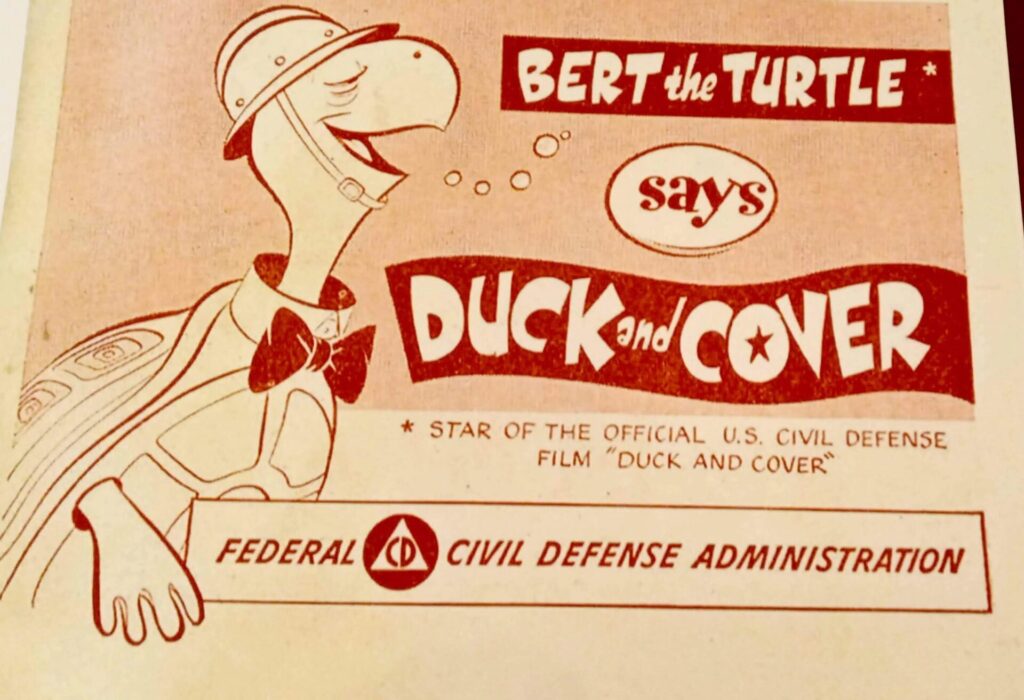
The ‘Duck and Cover’ drills, somewhat funny to us now, were serious business back then. They were meant to protect students from danger, even if the thought of a nuclear flash was pretty scary. It was all about shifting from pure fear to something more manageable, like turning a lemonade stand into a chocolate milk bar.
Critics wondered how huddling under a desk could withstand an atomic blast. But these exercises had a finer point – they helped students deal with fear. Teachers got creative, telling stories or holding impromptu concerts during drills to keep spirits up. It was like painting a bomb shelter in fun colors – maybe not practical, but comforting in its simplicity.
Bert became a cultural icon, as recognizable as the optimism of 1950s America. Those civil defense efforts, though often mocked later, sparked activism and fueled antiwar movements. It was a time when survival skills came with a side of whimsy, even in the face of nuclear threats.

Impact and Legacy of Civil Defense Drills
‘Duck and Cover’ drills danced their way into the nation’s psyche during the Cold War. Picture kids huddling under desks with the seriousness usually reserved for a pop quiz. Bert the Turtle’s antics were as unforgettable as grandma’s apple pie, and his advice became a survival playbook for 1950s schoolchildren.
These drills left quite an impression. For some, it was like a quirky school recital with a dash of duty. For others, it stirred up a bit of worry, like waiting for rain on a sunny day. As time went on, ‘Duck and Cover’ evolved from playful beginnings into something bigger.
Interestingly, these exercises sparked a generation of activists. Many who once ducked under desks later stood up against nuclear weapons. It’s funny how something meant to keep kids calm ended up inspiring them to speak out.
The value of these drills is up for debate. They made the scary idea of atomic war easier to swallow, like turning a math quiz into a game. But they also might have made people a bit too relaxed about a serious threat. Let’s face it, hiding under a desk probably wouldn’t do much against a nuclear blast.
In the end, ‘Duck and Cover’ was a creative, if imperfect, way to help a nation face the unthinkable. It’s a quirky reminder of 1950s ingenuity – when a catchy tune and a turtle in a shell were seen as tools to tackle the atomic age.
Ultimately, the story of ‘Duck and Cover’ isn’t just about drills or turtles. It’s a reminder of how a nation, in its own quirky way, sought to transform fear into something manageable. Through simple routines and catchy tunes, it taught resilience in an era shadowed by uncertainty. And perhaps that’s the lasting legacy—a blend of optimism and whimsy that turned anxiety into action.
- Brown JA. “A Is for Atom, B Is for Bomb”: Civil Defense in American Public Education, 1948-1963. J Am Hist. 1988;75(1):68-90.
- Davis T. Stages of Emergency: Cold War Nuclear Civil Defense. Duke University Press; 2007.
- Grossman A. Neither Dead nor Red: Civilian Defense and American Political Development During the Early Cold War. Routledge; 2001.