
Etiquette and Social Norms
In the 1950s, respect was paramount. You'd stand up straight when an elder entered the room, showing you valued their wisdom. Talking back to adults was strictly forbidden unless you were prepared to face consequences. It was sometimes challenging, but that's how society functioned back then.
Polite language wasn't optional – it was expected. "Please" and "Thank you" were the norm, whether at the family table or chatting with neighbors. Schools were like mini-societies where every teacher was addressed as "Sir" or "Madam." Children learned respect alongside their ABCs, standing when a teacher entered and greeting them each morning.
At home, manners were rigid. You needed permission to leave the dinner table, akin to asking a king for leave. Parents and schools collaborated to ensure every youngster had impeccable manners.
Opening doors or giving up bus seats wasn't just polite – it demonstrated proper upbringing. And if you forgot, those around you were quick to remind you. Times change, but good manners never go out of style.
Key Etiquette Rules of the 1950s:
- Stand when an adult enters the room
- Use "Please" and "Thank you" consistently
- Address teachers as "Sir" or "Madam"
- Ask permission to leave the dinner table
- Offer your seat to elders or women on public transport
- Open doors for others

Dating and Courtship Rituals
Dating in the 1950s was governed by structured rituals. Boys had to muster courage to ask a girl out, typically by phone – hoping her father wouldn't answer first! If he secured a date, he was expected to bring a corsage to show she was special.
Chivalry was key. The gentleman would:
- Order for both at dinner
- Hold doors open
- Walk on the street side of the sidewalk
It was all about demonstrating his ability to care for his date.
"Going steady" was a significant commitment – like a contract of exclusivity. Couples might exchange a letterman sweater or pin to signify their serious intentions.
These rituals may seem quaint now, but they guided relationships step-by-step. Of course, they also reinforced strict gender roles – boys pursued and planned, while girls were expected to be admired and keep their feelings in check.
While we've moved on from some of these old-school ways, there was a certain magic to that era of romance. Holding hands was a milestone, and a first kiss felt like fireworks.
"If he decides to skip the dance and go rowing on the lake, go — even if you are wearing your best evening gown"– McCall's Magazine, 1958
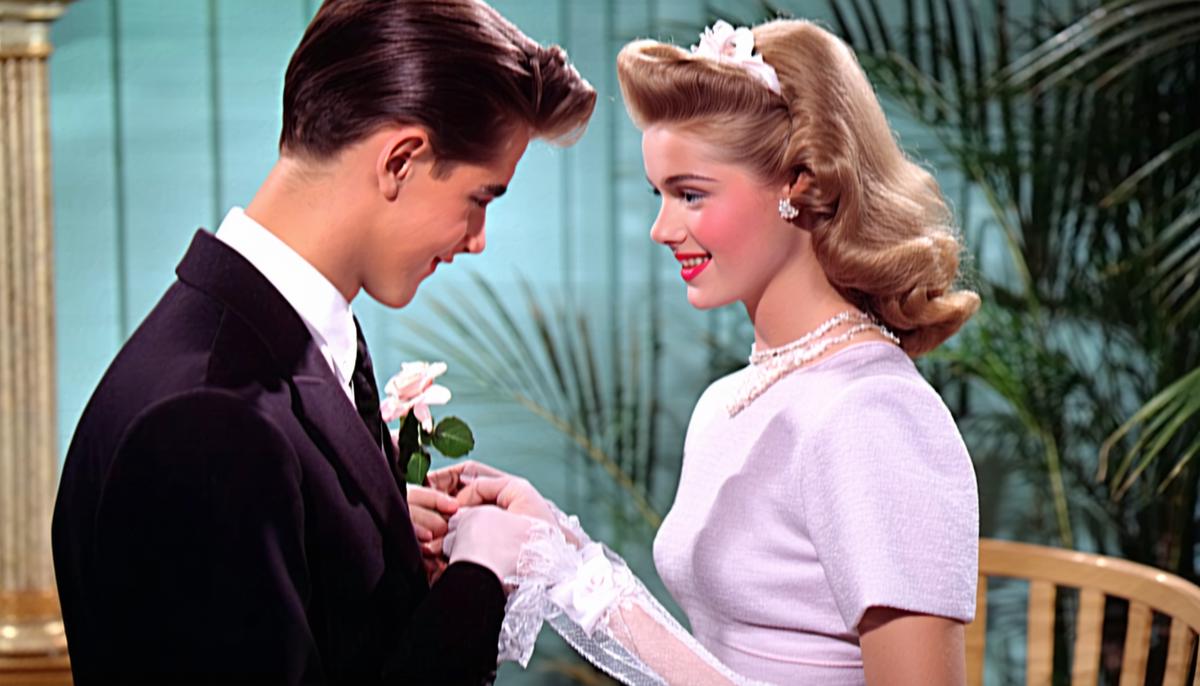
Family Dynamics and Manners
In the 1950s, families were central to teaching manners and etiquette. Parents led by example, showing children how to behave both at home and in public. No detail was too small in this daily practice of social graces.
Family meals were sacred. Dinners were when everyone came together to share their day and learn polite conversation. Children practiced passing dishes and saying "please" and "thank you" – skills that would serve them well in life.
Expectations for children were clear, and breaking rules had consequences. Parents modeled good behavior, turning everyday life into lessons on respect and courtesy. How mom and dad treated each other set the standard for all relationships.
Children watched closely and emulated their parents' actions. If Dad tipped his hat to a neighbor, his son would do the same. Mom's politeness to strangers became her daughter's habit. This way, good manners were passed down naturally from one generation to the next.
Key Family Etiquette Points:
- Family meals were a time for unity and learning
- Children learned by observing parents' behavior
- Clear expectations and consequences for behavior
- Everyday interactions used as teaching moments
- Respect and courtesy modeled within the family
The 1950s emphasized respect and manners in daily life. While times have changed, the era's focus on courtesy and family connection still holds value today. As we navigate modern social norms, perhaps we can draw inspiration from the past, balancing traditional politeness with contemporary sensibilities.
-
1. Young WH, Young NK. The 1950s. Greenwood Press; 2004.
2. Gracián B. The Etiquette Collection. Greenwood Press; 2004.
3. Bailey BL. From Front Porch to Back Seat: Courtship in Twentieth-Century America. Johns Hopkins University Press; 1988.