
Let’s travel back to 1951 Seattle, where the Anderson brothers – Archie, Dean, and Eldon – were about to shake up the car wash industry. Forget screechy plastic-bristle brushes and manual labor. These gents rolled out something that turned car washes into a nifty experience.
The Anderson Brothers’ Car Wash Revolution
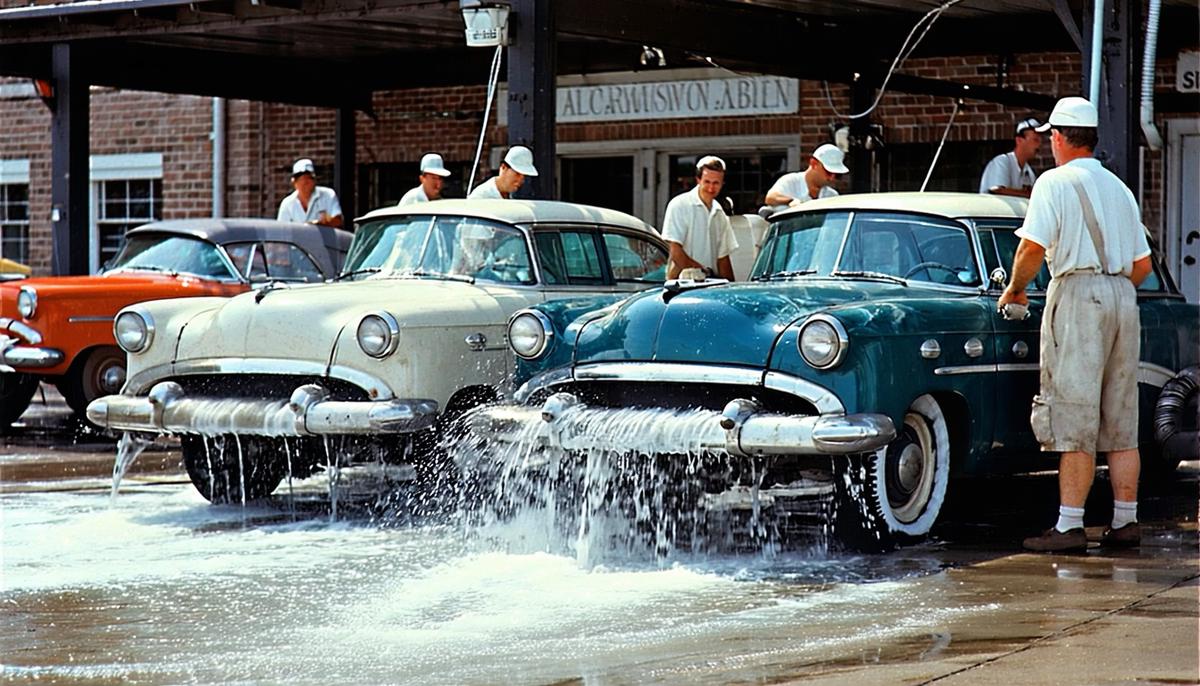
Picture this: a car wash so automatic it practically waved cars through like a dance partner at a sock hop. The brothers had crafted hands-free machines that cleaned cars safer than ever before. Cars glided through the tunnel on a winch, leaving behind that assembly line work where folks used to soap, rinse, and dry each car by hand.

The Andersons, driven by innovation, set out to revolutionize the industry. This wasn’t just a step forward; it was a leap, hopping over the old ways with style. It turned a necessary chore into something fast, easy, and a bit of a spectacle. They didn’t just innovate; they changed the whole game, making every car’s trip through the wash a smooth ride.
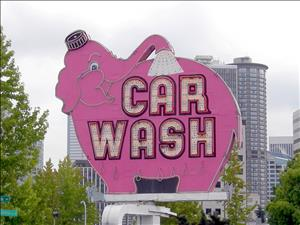
Archie had a knack for big ideas, and his vision for a pink elephant became the iconic face of their car wash. Inspired by an elephant’s “built-in water hose,” he saw the potential for a memorable name and logo. The neon pink elephant was more than just a quirky nod to 1950s pop culture—it was a statement. Designed by Seattle’s neon queen Beatrice Haverfield, the attention-grabbing sign shimmered with a rotating pink elephant surrounded by baby elephants with little bows, welcoming drivers from every direction. The strategy? A bold, fun symbol that made getting a car wash feel like a can’t-miss occasion.

From Elbow Grease to Automation
Before the Anderson brothers’ innovation, car washing was an enterprise that required more elbow grease than elegance. It was all about hard work, stationed employees, and the arduous tango of sponges, buckets, and suds. Workers hustled like a small army, each one with a single mission: make that car shine.
The early winch system was a step above pure manual labor, pulling cars through tunnels, but we were far from perfection. Employees still stuck by, soaping and rinsing by hand, channeling the spirit of assembly lines. It was progress, but progress with room for improvement.
Then came the Anderson brothers' system, where cars experienced motions nearly as smooth as a crooner's voice. Gone were the days of risk and rough brushwork; here was a shining, steel-track wonder.
People caught wind of something that felt less like a chore and more like a treat. The Andersons’ pioneering autopilot was proof that progress was achievable, even in the mundane.
The Ripple Effect of Innovation
What did Seattle gain from this high-speed opus? Suddenly, time slowed down for everyone except the speeding, sparkling vehicles. Drivers weren’t tethered to long waits and tired old elbow grease. The revolution offered them more of their most precious commodity: time.
The Andersons weren’t just stirring up suds; they were mixing a cocktail of efficiency that had folks sipping from the future. They showed Seattle and beyond how innovation could shine, guiding other corners of the car wash industry. It was a trailblazer moment, sparking that enticing concept that sprang across industries—automation done right, turning tedious tasks into seamless symphonies.
The broader implications of this nifty nugget in car maintenance hinted at a burgeoning world of automated services. This first step into automation laid the groundwork for tech visions and dreams that would someday groove into the very fabric of our lives.
As we look back on the history of automated services, this automatic car wash holds a special spot. A celebration of what was once unthinkable, turned standard—a nod to the past while steering us toward the future. In Seattle, watching the magic unfold, it felt like the start of something big.
- Anderson D, Anderson A, Anderson E. The History of Elephant Car Wash Seattle. Seattle: Elephant Car Wash; 1951.