
Historical Background of Copying
The journey from quill to photocopier was quite the ride. Back in 1780, James Watt invented the book press—a contraption that made a single, messy duplicate of a document. Writers had to use special papers and moist ink, resulting in rough copies that were barely legible. It wasn't great, but it beat rewriting from scratch.
In 1950, 3M introduced the Thermo-Fax, which used infrared light and heat-sensitive paper. It was a step up from the book press, but had its quirks:
- The chemical paper curled up
- The smell was less than pleasant
- Papers were expensive
Then came 1959, and the Xerox 914 changed everything. This 650-pound machine brought in a new era of document duplication. Thanks to Chester Carlson's xerography process, it made sharp copies on plain paper.
Carlson, who knew the struggle of smudged carbon copies, teamed up with Joseph C. Wilson to bring this innovation to offices everywhere. Their creation wasn't just a gadget; it was a game-changer.
The Invention of Xerography
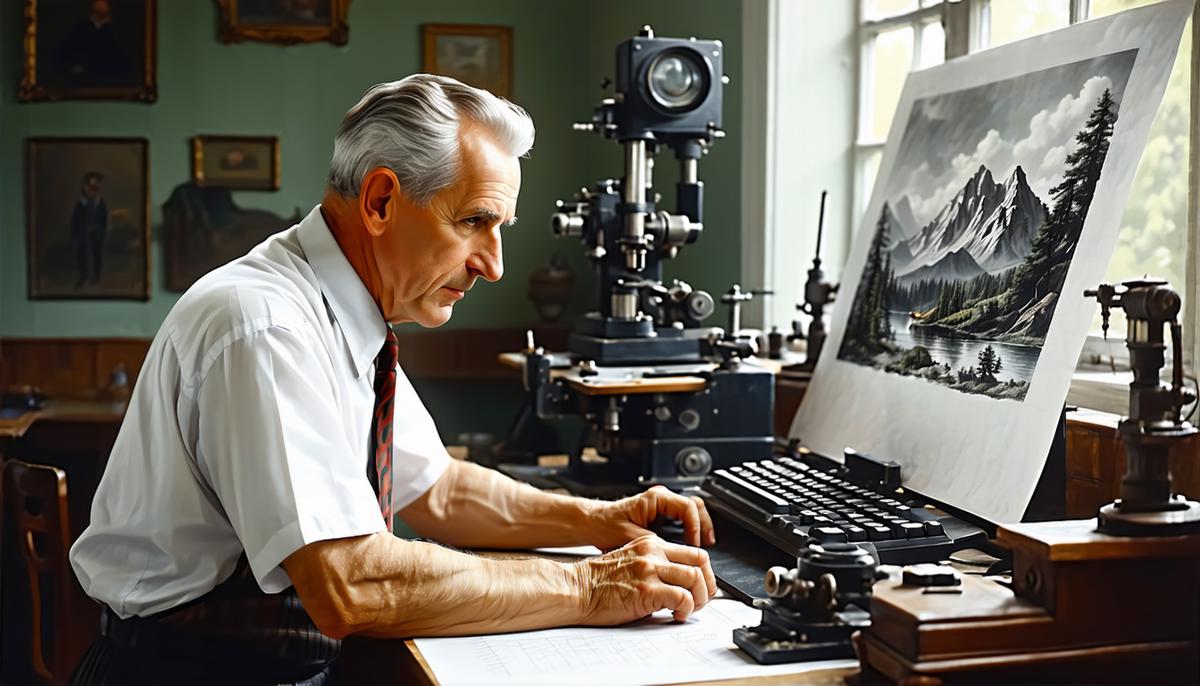
Chester Carlson, a patent attorney with ink-stained fingers, dreamed up xerography in the 1930s. Frustrated by smudged patent documents, he envisioned a device that would make duplication easier.
With minimal funds and an untested idea, Carlson set up a modest home lab. In 1938, he had his eureka moment: using static electricity to transfer images. He called it "electrophotography," though that's quite a mouthful.
Enter Joseph C. Wilson, a businessman who saw potential where others didn't. Together, they refined the concept into "xerography," meaning "dry writing" in Greek. Unlike its messy predecessors, xerography was clean and efficient.
Their collaboration led to the Xerox 914, a machine that did away with chemical reliance. It used electrostatically charged magic and toner to produce clean, dry copies. This shift from damp, wrinkly norms marked a turning point in copying history.
"When we say ordinary paper, we mean ordinary paper. For instance, office stationery. Or how about plain bond paper? Now if that isn't ordinary enough, wait a minute."
– From a Xerox 914 advertisement
Xerox 914's Impact on Offices
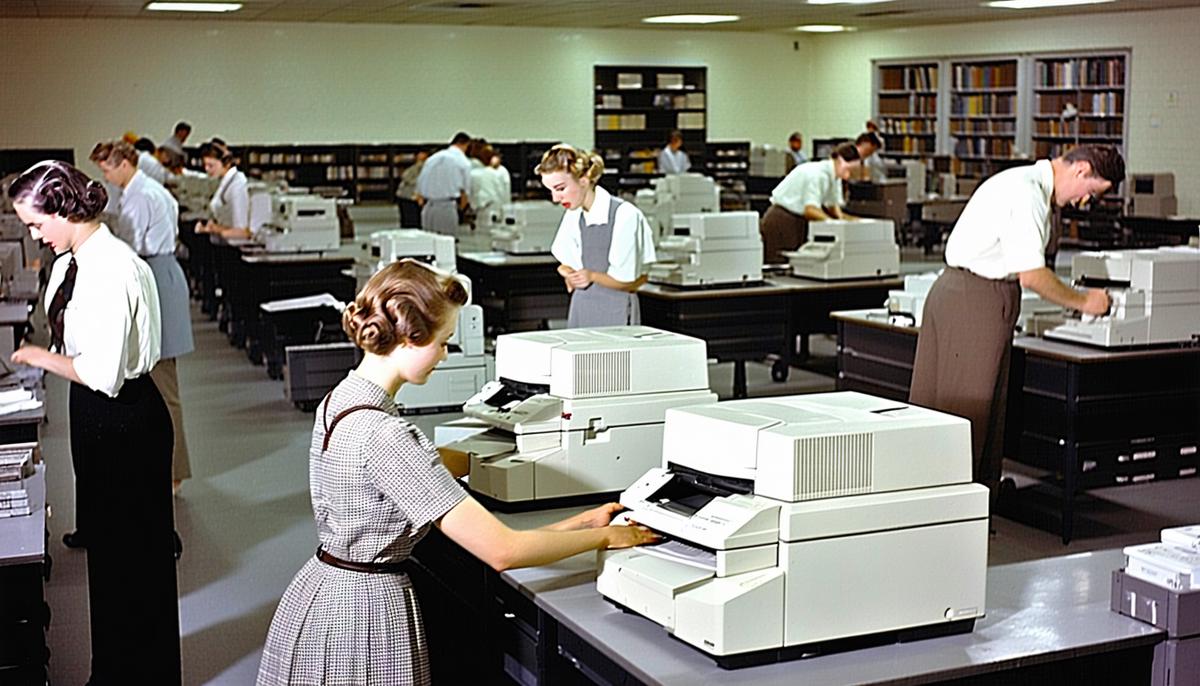
The Xerox 914 transformed 1950s offices, turning document duplication from a chore into a breeze. Before its arrival, making copies involved stacks of carbon paper and endless retyping. The 914 changed all that, churning out duplicates at lightning speed.
This machine boosted productivity significantly. Office workers spent less time on repetitive paperwork and more on creative tasks. Meetings ran smoother with easily distributed copies. Companies could focus on expanding and innovating, no longer bound by manual copying limitations.
The 914 also democratized information. Knowledge became more accessible, improving communication within businesses. Collaboration flourished across departments, elevating the entire workplace atmosphere.
In many ways, the Xerox 914 was a symbol of progress. It didn't just multiply paper; it multiplied opportunities. The cultural landscape of office life shifted, as this machine spoke the universal language of efficiency.
Legacy and Cultural Significance
The Xerox 914's legacy has only grown stronger over time. It sparked a wave of technological advancements that went beyond its era. Future copying technologies built upon its principles of simplicity, reliability, and accessibility.
The humble copier evolved rapidly, incorporating new digital advances. Multifunction devices that could scan, fax, and print emerged, all tracing their roots back to the 914.
The 914's influence extended to information management practices. It became a blueprint for data democratization, allowing knowledge to flow freely. This forever altered how businesses shared ideas and preserved information.
The cultural impact of Xerox technology reached beyond the office. It paved the way for faster, broader information sharing in society at large. The 914 encapsulated the inventive spirit of the 1950s, standing as a monument to human ingenuity and ambition.
Interesting Facts:
- By 1965, Xerox had over $500 million in revenue1
- In 2013, the world produced an estimated three trillion xerographic copies1
- Chester Carlson was inducted into the National Inventors Hall of Fame in 19812
The Xerox 914 wasn't just a machine; it was a turning point in productivity and communication. It reshaped office life, made information more accessible, and continues to inspire us today. Its legacy reminds us how determination and creativity can transform our everyday experiences.
- Anonymous. The History of the Office Copier. Stafda.org.
- Anonymous. 1959: Photocopier. National Inventors Hall of Fame.